Hello there,
greetings once more. On this occasion, I am presenting you with relevant
information on the use and information about the Adverb.
Let's start with this interesting presentation.
To begin we must understand that an Adverb is an
invariable word that modifies: the sense of a verb, the meaning of the
adjective, the meaning of another adverb and the position of the speaker.
Also from the point of view of its meaning, the
adverbs can be classified according to seven categories:
1. Adverbs of manner: well, hard, evil, rather,
better, faster, too, etc.
2. Adverbs of quantity: enough, too much, more, less,
much, very, little, so, so much, etc.
3. Adverbs of time: now, sometimes, yesterday, then,
then, today, then, tomorrow, never, soon, always, late, early, still, already,
etc.
4. Adverbs of place: in, there, around, here, below,
in front, inside, behind, above, outside, etc.
5. Adverbs of affirmation: yes, etc.
6. Adverbs of denial: hardly, almost, no, never, etc.
7. Adverbs of doubt: perhaps, etc.
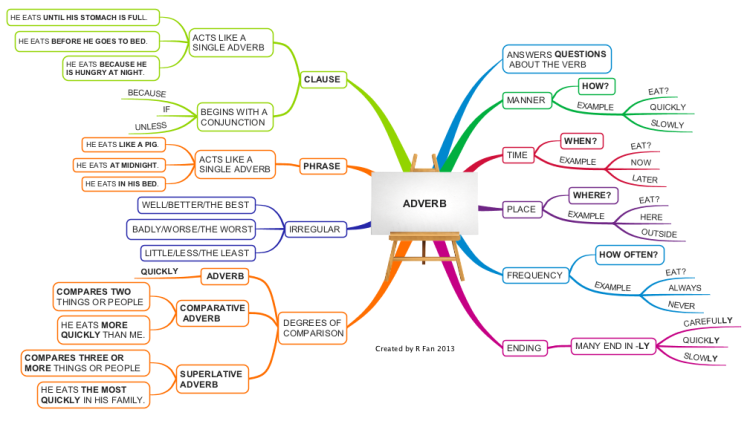
It is easy to see how adverbs describe, or modify,
verbs, since they simply explain most about the action and also also describe
adjectives or other adverbs. They provide more information about that other
descriptive word.
We can tell whether or not a word is an adverb by considering its function in
the sentence. If it is describing one of those three parts of speech- a verb,
adjective or other adverb- it is an adverb.
I hope you liked the information in reference to the
Adverb.

Hi dear Javier! Thanks for sharing new information with everyone, it always come in handy. Something new I learned is some adverbia categories. Despite that I have a doubt, can a verb or an adjective act as an adverb?
ResponderEliminarHello Javi. Your post was really good. I understood every detail of it. I understood that adverbs can modify a verb, and adjective or another adverb. And the way to recognize one is by looking at its function in the sentence, for example if it is describing or modifying a verb showing how was the action performed, etc. So, for this topic I have one little question, is there a difference between adverbs and adverbials?
ResponderEliminarHello Javi! What a nice blog. I liked it a lot because adverbs has always been a headache to me. The information you presented is really interesting because there are a great variety of adverbs and they help us to describe the verbs. I did not know that there were so many categories. The picture you posted helped me with it. I just have a doubt. I know that the majority of adverbs are formed by adding -ly to the adjective but If use the adjective "fast" can I say "fastly" to use it as adverb?
ResponderEliminarHi Javier!
ResponderEliminarI really liked your post because you give us a lot of information about adverbs! Thanks to your blog I has helped me to know that they have many categories, it to interesting!
By the way just a little doubt, About the irregular adverbs do they have the same usage as the others or does the usage change?
Thanks you!
Hello Javi
ResponderEliminarI really like reading your post because you explined the topic very nice, it also liked me, because the content that you share is important and useful, I know that we were studed this in the grammar classes the last semester and but I forget the uses of the Adverbs, but now thanks to your post I reinforced my knowledge about Adverbs. I just have a question there are othes categories of the adverbs.
Thank you Javi!!
Hi Javier!
ResponderEliminarNice to read you again, I liked your blog very much, I read it and I was enjoying the lecture because adverbs are very important.
I just have one doubt about it, adverbs just modify a verb or something else on a sentence?
Thank you