RELATIVE CLAUSES
Hello colleagues, in my second blog I present essential information on the use of Relative Clauses, as well as different examples where it is shown in a specific way its terms and applications.
Relative clauses are non-essential parts of a sentence. They may add meaning, but if they are removed, the sentence will still function grammatically. There are two broad types of relative clauses in English. It is important to distinguish between them because it affects the choice of pronoun used to introduce the clause. There is a more detailed page about preposition placement in relative clauses.
Relative clauses are non-essential parts of a sentence. They may add meaning, but if they are removed, the sentence will still function grammatically. There are two broad types of relative clauses in English. It is important to distinguish between them because it affects the choice of pronoun used to introduce the clause. There is a more detailed page about preposition placement in relative clauses.
DEFINING CLAUSES
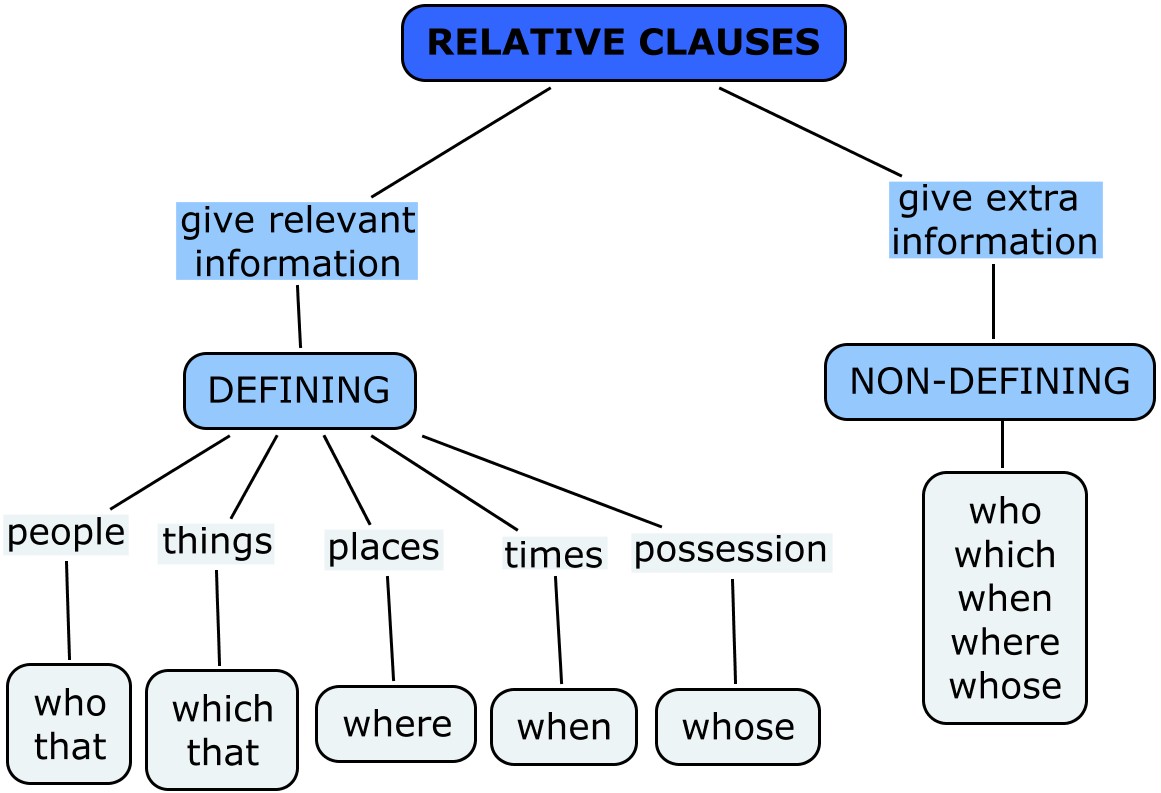
A defining or identifying clause tells us which specific person or thing we are talking about in a larger group of people or things. If a defining relative clause is removed, the meaning of the sentence changes significantly. A defining relative clause is not separated from the rest of the sentence by commas or parentheses.
EXAMPLES
- The woman who visited me in the hospital was very kind.
- The umbrella that I bought last week is already broken.
- The man who stole my backpack has been arrested.
- The weather that we had this summer was beautiful.
Learn more about using defining relative clauses correctly.
NON-DEFINING CLAUSES
A non-defining or non-essential clause gives us more information about the person or thing we are talking about. If a non-defining relative clause is removed from a sentence, we lose some detail, but the overall meaning of the sentence remains the same. Non-defining relative clauses are always set off from the rest of the sentence with commas or parentheses.
EXAMPLES
- The farmer, whose name was Fred, sold us 10 pounds of potatoes.
- Elephants, which are the largest land mammals, live in herds of 10 or more adults.
- The author, who graduated from the same university I did, gave a wonderful presentation.
- My mother, who is 86, lives in Paris.
What are relative clauses?
A relative clause is a subordinate clause that modifies a noun or a noun phrase.
Example:
The man who is smoking is the murderer
The noun the man is modified by the relative clause who is smoking.
Relative clauses give essential information to define or identify the person or thing we are talking about.How to use relative clauses
They are used to provide extra information. This information can either:
- define something (defining clause),
Example:
The girl who is standing there is a world champion in karate. - or provide unnecessary, but interesting information (non-defining clause).
Example:
Michael Jackson, who was a famous singer, died of an overdose.
- A relative pronoun: who, whom, which, that, whose.
Example: "The man who is standing there is a famous writer." - A relative adverb: where, why and when.
Example: " The restaurant where I have dinner is nice." - None of them.
Example: "The man I met is extremely wealthy"
Relative Pronouns
who - subject or object pronoun for people
They caught the lady who killed her baby.
which - subject or object pronoun
I read the book which is on the table.I visited the town which you told me about.
which - referring to a whole sentence
They were unsuccessful which is disappointing.
whom - used for object pronoun for people, especially in non-restrictive relative clauses (in restrictive relative clauses use who)
The boy whom you told me about got the best grades in mathematics.
that - subject or object pronoun for people, animals and things in restrictive relative clauses (who or which are also possible)
I like the vase that is over there.
Relative adverbs
where - referring to a place
The restaurant where I usually have dinner is nice.
when - referring to a time
There are times when I feel so lonely.
why - referring to a reason
This is why she refused the offer.
Subject Pronoun or Object Pronoun?
You can distinguish subject and object pronouns as follows:
- If the relative pronoun is not followed by a noun or pronoun, it is a subject pronoun. Subject relative pronouns can never be omitted (dropped.)
Example:
The apple which is lying on the table is sweet.
The teacher who lives next door is nice. - If the relative pronoun is followed by a noun or pronoun, the relative pronoun is an object pronoun. Object relative pronouns can be omitted (dropped) in restrictive (defining) relative clauses.
Example:
The film (which) we watched yesterday was fantastic.
The writer (who/whom) we met last weekend is very famous.
Restrictive Relative Clauses
1. Restrictive (identifying or defining) relative clauses give detailed necessary information. They are not put between commas.
I know the man who is standing there
2. These clauses are often used in definitions.
A novelist is someone who writes novels.
3. Object pronouns in these clauses can be omitted (dropped.)
Example:
The boy (who/whom) we met yesterday is from New York.Non-Restrictive Relative Clauses
Non- restrictive (non-identifying or non- defining) relative clauses give interesting additional information which is not necessary to the meaning of the sentence. These clauses are put between commas.
Example:
Note:
Martin Luther king, who was known for his fight for the civil rights, was assassinated in 1968.
In non restrictive relative clauses:
1. who/which may not be replaced with that.
Example:
2. Object relative pronouns cannot be dropped.
Jim, who we met yesterday, is very nice.
NOTJim, that we met yesterday, is very nice.
Example:
Jim, who we met yesterday, is very nice.
NOTJim,we met yesterday, is very nice.
- define something (defining clause),

Hello, Javier. I personally think this is a difficult topic to explain but the way you presented it was so understandable. Now I know that the definig clauses tell us what kind or category out of others you are referring to inside the conversation. And the nondefining clauses can be taken out and the main sentence does not looses its main idea. This really helped, I don't have any doubt or questions, you have already cleared them. See you!!!
ResponderEliminarHi Javi
ResponderEliminarI consider the information about relative clauses that you shared with us is really significant and useful because it shows to be a simple topic, but for me it isn´t because it relates many things, and at the beginning it was a little bit difficult to identify relative clauses but with your post help me a lot, and also has help me to know that Relative clauses can be introduced by: a relative pronoun: who, whom, which, that, whose; Well I don´t have doubts about the topic.
Thanks Javi...
Hi Javier, nice post!
ResponderEliminarYou know, for me it was very difficult to understand what relative clauses are but with your blog I have a broader knowledge about the topic.
Just a question, can we use more than one relative clause in a sentence?
I like your post, has a lot of information and also examples, but this still confuses me a lot, because I don’t understand what is the difference between a non-defining clause and a relative clause, you post a lot of examples and explain about the relatives clauses, but I still confused, maybe you can solved my doubt about what is the difference between both ☹️
ResponderEliminarAnyway, thanks for the information! 😺
Hi, man!
ResponderEliminarThat's a great post! It was difficult to catch ideas about it. But thank's God you posted it! Now I have many ideas to expose when people ask me about it.