viernes, 20 de octubre de 2017

domingo, 15 de octubre de 2017
Adverb.
Hello there,
greetings once more. On this occasion, I am presenting you with relevant
information on the use and information about the Adverb.
Let's start with this interesting presentation.
To begin we must understand that an Adverb is an
invariable word that modifies: the sense of a verb, the meaning of the
adjective, the meaning of another adverb and the position of the speaker.
Also from the point of view of its meaning, the
adverbs can be classified according to seven categories:
1. Adverbs of manner: well, hard, evil, rather,
better, faster, too, etc.
2. Adverbs of quantity: enough, too much, more, less,
much, very, little, so, so much, etc.
3. Adverbs of time: now, sometimes, yesterday, then,
then, today, then, tomorrow, never, soon, always, late, early, still, already,
etc.
4. Adverbs of place: in, there, around, here, below,
in front, inside, behind, above, outside, etc.
5. Adverbs of affirmation: yes, etc.
6. Adverbs of denial: hardly, almost, no, never, etc.
7. Adverbs of doubt: perhaps, etc.
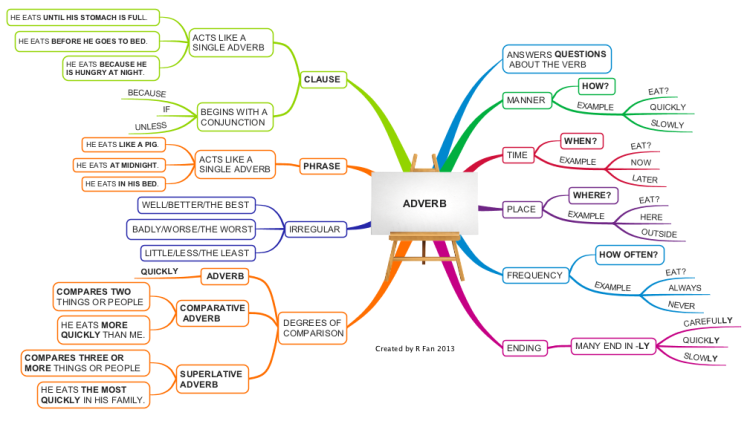
It is easy to see how adverbs describe, or modify,
verbs, since they simply explain most about the action and also also describe
adjectives or other adverbs. They provide more information about that other
descriptive word.
We can tell whether or not a word is an adverb by considering its function in
the sentence. If it is describing one of those three parts of speech- a verb,
adjective or other adverb- it is an adverb.
I hope you liked the information in reference to the
Adverb.
viernes, 6 de octubre de 2017
The Passive.

Hello everyone and welcome back to my fifth delivery of Blog.
The Passive.
On this occasion I will share information about the importance, use and definition of the passive. With which, I hope you will be very helpful in using it or putting it into practice.
We must understand that a Passive is divided or subdivided into three parts that are: the active subject, the passive subject and the pseudo-object. To have a better view of each of these, I will share their respective definition.
As an active subject we can understand that he is responsible for performing the action indicated by the verb (which is characterized when the verb is copulative). This in turn coincides in number and person with the verb.
On the other hand we have the passive subject, who instead does not perform the action indicated by the verb, but receives it. In the same way as the asset, the passive also agrees in number and person with the verb. The passive subject is found in passive sentences, in which the speaker wants to perform the direct complement object CoD; therefore we will not find it in copulative sentences (to be, to appear).
To conclude we add the third subject that is the Pseudo-object. This is the same as the active and passive, although unlike the asset, this is not the one that performs the action indicated by the verb, and unlike the passive, this is not in a passive sentence.

Suscribirse a:
Comentarios (Atom)