domingo, 19 de noviembre de 2017

USED TO vs BE USED TO

Last Blog, has really been a significant learning in everything related to grammar. A different way to learn and interact with everyone and share different experiences.
  Thank you all for your time and your comments.
On this occasion I will share information regarding Used to vs. Be used to, various exercises and relevant information on its use and performance.
Let's start ...


Used to shows:
  • a particular thing always happened or was true in the past.
  • But it no longer happens or is no longer true now:
Examples:
  • David used to live in Madrid.
  • She used to exercise every morning, but since she had that terrible accident she doesn't exercise anymore.
  • Why don't you come and see me like you used to?

Forms of used to.
Here are the interrogative, affirmative and negative forms of used to:
Did you use to exercise regularly?
Yes, I used to go jogging nearly every day.
No, I didn't use to exercise on a regular basis.
Use of be used to
The be used to expression is for talking about something that is familiarto us or easy for us. For example:
  • am used to driving on the left.
It means that it is not a problem for me to drive on the left of the road. I am Japanese. In Japan, people drive on the left. Now I am living in the USA where people drive on the right. Of course, I drive on the right in the USA, but when I go to Japan it is easy for me to drive on the left because "I am used to it".
Look at these examples.
  • am used to hard work.
  • am used to working hard.
  • He is not used to New York.
  • He isn't used to living in New York.
  • Are you used to fast food?
  • Are you used to eating quickly?
Tenses
We can use be used to in any tense. We just conjugate the verb be in the tense that we need. Look at these examples:
  • When we lived in Bangkok, we were used to hot weather.
  • have been used to snakes for a long time.
  • You will soon be used to living alone.

The structure of be used to is:
subject
+
main verb
be
+
used to
+
object
Look at the structure again with positive, negative and question sentences:

subject
main verb
be
not
used to
object
+
I
am

used to
horses.
-
He
is
not
used to
children.
We
are
n't
used to
big cities.
?
Are
you

used to
her temper?


lunes, 13 de noviembre de 2017

Participial Adjetives.

Hello everyone, here I present my new entry concerning the Adjective Participial.
Based on this we can know that it is an Adejective Participial, as well as being able to identify it; and in turn which is the function that this one performs.

These participial adjectives are hard to distinguish because often, they look like verbs, past participles, and other adjectives. This is because they often end in –er or –ing. Sometimes, they look like comparative adjectives, too – but they are not always serving this function grammatically.

Identifying a Participial Adjective

The participial adjectives are:

 A major subclass of adjectives.They can be distinguished by their endings, usually either –er or –ing.  Some exceptions to the rules include misunderstood and unknown, which also function like these special adjectives. They are called participial adjectives because they have the same endings as verb participles.

Students who wonder, what is a participial adjective, might be confused by the way that they have been explained in their grammar lessons or might not be sure how they function in a sentence. These participial adjectives are hard to distinguish because often, they look like verbs, past participles, and other adjectives. This is because they often end in –er or –ing. Sometimes, they look like comparative adjectives, too – but they are not always serving this function grammatically.

Identifying a Participial Adjective

The participial adjectives are a major subclass of adjectives.They can be distinguished by their endings, usually either –er or –ing.  Some exceptions to the rules include misunderstood and unknown, which also function like these special adjectives. They are called participial adjectives because they have the same endings as verb participles.

Function in a Sentence

These adjectives are really meant to function like any other adjective: they help to describe a noun. They might come from a verb form, or they might merely imitate the structure, but they always function as a descriptive adjective.

Let’s look at some examples of participial adjectives in sentences below. After each example, the adjective is placed in parentheses.
Some example sentences have more than one adjective.

The tempting cookie platter made my mouth salivate. (tempting)
The fascinating book was a thrilling read.  (fascinating, thrilling)
The interesting story made a compelling point. (interesting, compelling)
Sally was bored by the conversation. (bored)
I am tired today, and my work is really tiring. (tired, tiring)
My frustrating experience at the restaurant made me angry. (frustrating)
I have been agitated long enough. (agitated)

These adjectives form a very large portion of all of the adjectives in the English language and help us be more accurate in our description of people, places, things, and experiences when we speak and write.
 The students who wonder, what is a participial adjective, might be confused by the way that they have been explained in their grammar lessons or might not be sure how they function in a sentence. These participial adjectives are hard to distinguish because often, they look like verbs, past participles, and other adjectives. This is because they often end in –er or –ing. Sometimes, they look like comparative adjectives, too – but they are not always serving this function grammatically.

Identifying a Participial Adjective

The participial adjectives are a major subclass of adjectives.They can be distinguished by their endings, usually either –er or –ing.  Some exceptions to the rules include misunderstood and unknown, which also function like these special adjectives. They are called participial adjectives because they have the same endings as verb participles.

Function in a Sentence
These adjectives are really meant to function like any other adjective: they help to describe a noun. They might come from a verb form, or they might merely imitate the structure, but they always function as a descriptive adjective. Let’s look at some examples of participial adjectives in sentences below. After each example, the adjective is placed in parentheses. Some example sentences have more than one adjective.

The tempting cookie platter made my mouth salivate. (tempting)
The fascinating book was a thrilling read.  (fascinating, thrilling)
The interesting story made a compelling point. (interesting, compelling)
Sally was bored by the conversation. (bored)
I am tired today, and my work is really tiring. (tired, tiring)
My frustrating experience at the restaurant made me angry. (frustrating)
I have been agitated long enough. (agitated)

These adjectives form a very large portion of all of the adjectives in the English language and help us be more accurate in our description of people, places, things, and experiences when we speak and write.

Adjectives From a Verb

You might be wondering, what is the origin of all of these participial adjectives? Why do we have so many of these strange words that look like certain verb forms? Some of the participial adjectives that end in –ed have a corresponding verb form, whereas some participial adjectives do not.

In other words, some adjectives only look like they come from verbs – and we still call them participial adjectives. In this way, “to excite” becomes “excited” and “to determine” becomes “determined”. However, there is no “to talent” that forms the participial adjective “talented.”

It is more common that the participial adjectives that end in –ing have a corresponding verb form. These include annoying, exasperating, worrying, thrilling, misleading, gratifying, and time-consuming.

These adjectives do not just come in one form. You can modify participial adjectives to increase or decrease their intensity and use them to compare different nouns. This can be accomplished by using the words very, extremely, and less, or by forming comparative and superlative forms.


viernes, 3 de noviembre de 2017

Transitive and Intransitive Verbs.

Hello everyone, this time my blog refers to transitive and intransitive verbs; taking them as reference because it was the last seen in class where we developed the activity in which you need to learn as many intransitive verbs as possible.

 Let's start below your concepts and functions.
 Transitive verbs are those verbs that demand the presence of a direct element to obtain a complete meaning, that is, in an action that transits from the actor to the object.
From the syntactic point of view, this type of verb requires two participants: a natural one and another that is an object.
 Example: got two tickets to the concert. Here, the group consisting of "two tickets to the concert" represents the direct object.
 The construction "He achieved ..." has no meaning in itself, and requires that information be prepared on what is achieved.
 As a general rule, transitive verbs are of the form "someone does something to something".
The intransitive verbs are those that do not admit or are not accompanied by a direct object, and do not require the presence of an object that determines the verb.
 This type of thing only needs a single participant.
 Example: Gisele delinque In this case, it is an intransitive verb, which does not require specifying a direct element, since the concept of "committing something" has no meaning in our language.
 In the use of verbs, these are not in themselves transitive or intransitive, but they can also be used according to their use, because it is possible to use intransitive and transitive verbs.
 Example: Jasmine sings an opera.
 Book to take into account the expression of transitive verbs without the presence of a direct element. Example: leave it to the Doctor, he sure understands it.
 There are few intransitive verbs in our language, compared to other languages ​​with a strong division between transitive and intransitive verbs.
 In general, in our language, the self-reflective form is available to denote intransitivity.


Resultado de imagen para transitive and intransitive verbs

I hope it helps you better understand what a transitive and intransitive verb consists of.
Thanks for your time and your comments.


viernes, 20 de octubre de 2017

domingo, 15 de octubre de 2017

Adverb.

Hello  there, greetings once more. On this occasion, I am presenting you with relevant information on the use and information about the Adverb.
Let's start with this interesting presentation.

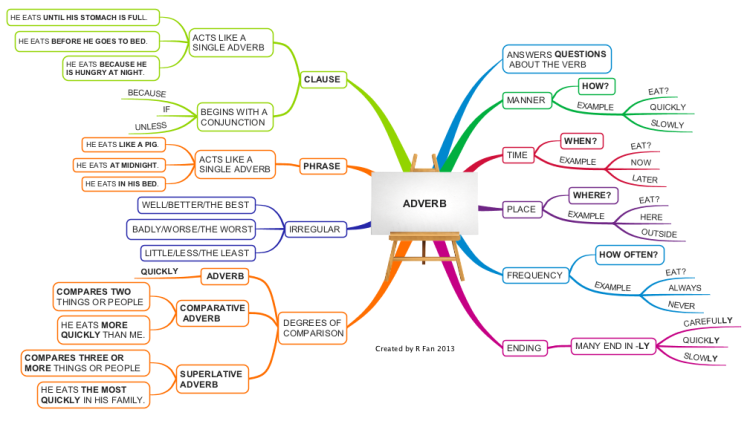
To begin we must understand that an Adverb is an invariable word that modifies: the sense of a verb, the meaning of the adjective, the meaning of another adverb and the position of the speaker.
Also from the point of view of its meaning, the adverbs can be classified according to seven categories:
1. Adverbs of manner: well, hard, evil, rather, better, faster, too, etc.
2. Adverbs of quantity: enough, too much, more, less, much, very, little, so, so much, etc.
3. Adverbs of time: now, sometimes, yesterday, then, then, today, then, tomorrow, never, soon, always, late, early, still, already, etc.
4. Adverbs of place: in, there, around, here, below, in front, inside, behind, above, outside, etc.
5. Adverbs of affirmation: yes, etc.
6. Adverbs of denial: hardly, almost, no, never, etc.
7. Adverbs of doubt: perhaps, etc.
Imagen relacionada
It is easy to see how adverbs describe, or modify, verbs, since they simply explain most about the action and also also describe adjectives or other adverbs. They provide more information about that other descriptive word.
We can tell whether or not a word  is an adverb by considering its function in the sentence. If it is describing one of those three parts of speech- a verb, adjective or other adverb- it is an adverb.


I hope you liked the information in reference to the Adverb.

viernes, 6 de octubre de 2017

The Passive.


Hello everyone and welcome back to my fifth delivery of Blog.
The Passive.
 On this occasion I will share information about the importance, use and definition of the passive. With which, I hope you will be very helpful in using it or putting it into practice.

 We must understand that a Passive is divided or subdivided into three parts that are: the active subject, the passive subject and the pseudo-object. To have a better view of each of these, I will share their respective definition.
 As an active subject we can understand that he is responsible for performing the action indicated by the verb (which is characterized when the verb is copulative). This in turn coincides in number and person with the verb.
 On the other hand we have the passive subject, who instead does not perform the action indicated by the verb, but receives it. In the same way as the asset, the passive also agrees in number and person with the verb. The passive subject is found in passive sentences, in which the speaker wants to perform the direct complement object CoD; therefore we will not find it in copulative sentences (to be, to appear).
 To conclude we add the third subject that is the Pseudo-object. This is the same as the active and passive, although unlike the asset, this is not the one that performs the action indicated by the verb, and unlike the passive, this is not in a passive sentence.

Imagen relacionada

jueves, 28 de septiembre de 2017

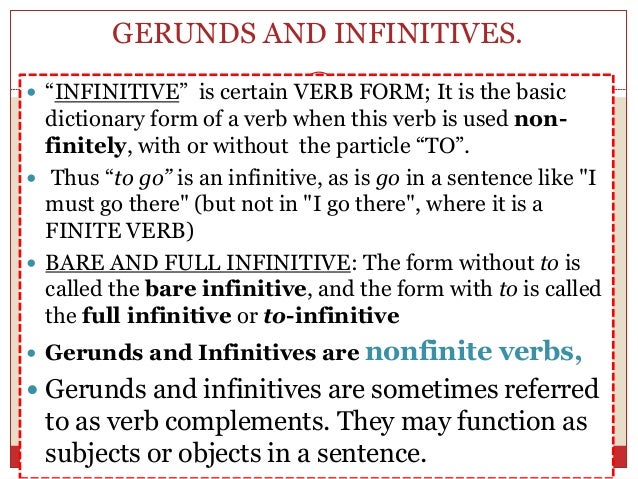
https://soundcloud.com/javi-guerra-991659360/gerunds-and-infinitives

Imagen relacionada

Resultado de imagen para gerunds and infinitives rules
 I hope that my presentation has been very helpful to you, and that it helps us to better understand the gerunds and infinitives.

viernes, 15 de septiembre de 2017

RELATIVE CLAUSES


Hello colleagues, in my second blog I present essential information on the use of Relative Clauses, as well as different examples where it is shown in a specific way its terms and applications.

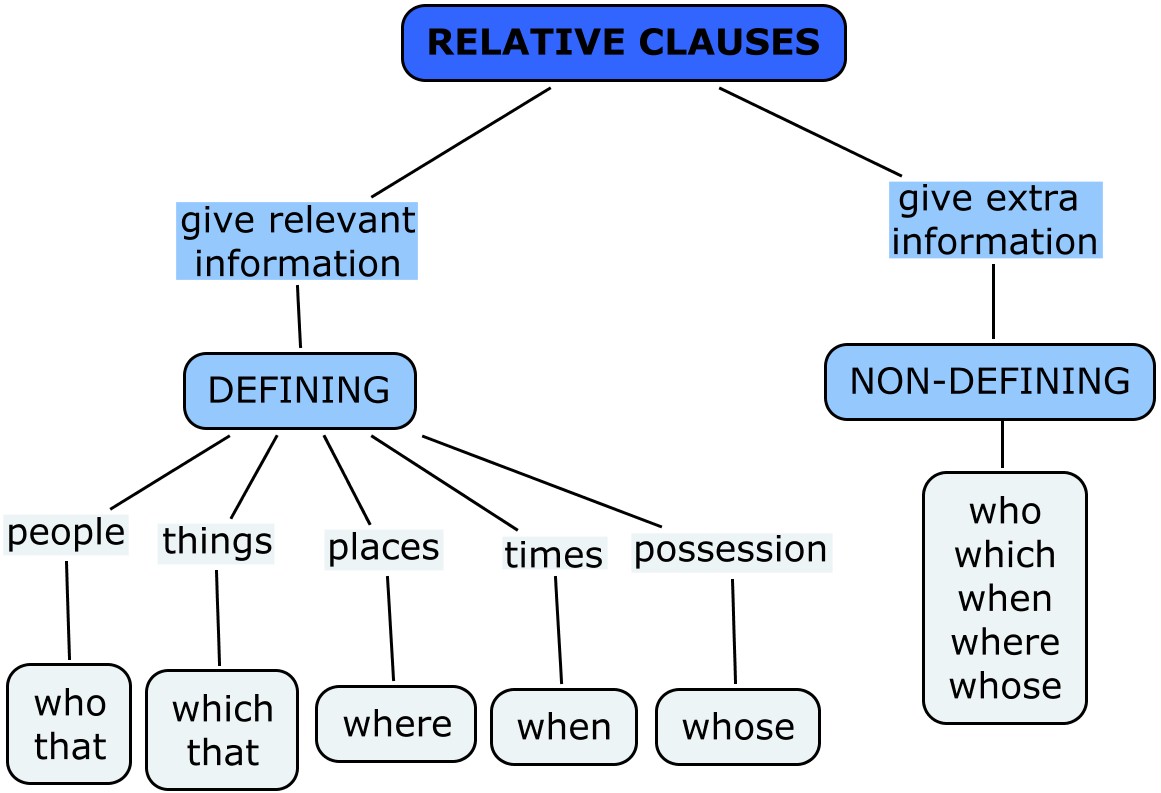
Relative clauses are non-essential parts of a sentence. They may add meaning, but if they are removed, the sentence will still function grammatically. There are two broad types of relative clauses in English. It is important to distinguish between them because it affects the choice of pronoun used to introduce the clause. There is a more detailed page about preposition placement in relative clauses.

DEFINING CLAUSES

defining or identifying clause tells us which specific person or thing we are talking about in a larger group of people or things. If a defining relative clause is removed, the meaning of the sentence changes significantly. A defining relative clause is not separated from the rest of the sentence by commas or parentheses.
EXAMPLES
  • The woman who visited me in the hospital was very kind.
  • The umbrella that I bought last week is already broken.
  • The man who stole my backpack has been arrested.
  • The weather that we had this summer was beautiful.
Learn more about using defining relative clauses correctly.

NON-DEFINING CLAUSES

non-defining or non-essential clause gives us more information about the person or thing we are talking about. If a non-defining relative clause is removed from a sentence, we lose some detail, but the overall meaning of the sentence remains the same. Non-defining relative clauses are always set off from the rest of the sentence with commas or parentheses.
EXAMPLES
  • The farmer, whose name was Fred, sold us 10 pounds of potatoes.
  • Elephants, which are the largest land mammals, live in herds of 10 or more adults.
  • The author, who graduated from the same university I did, gave a wonderful presentation.
  • My mother, who is 86, lives in Paris.
  • What are relative clauses?

    relative clause is a subordinate clause that modifies a noun or a noun phrase.
    Example:
    The man who is smoking is the murderer
    The noun the man is modified by the relative clause who is smoking.
    Relative clauses give essential information to define or identify the person or thing we are talking about.

    How to use relative clauses

    They are used to provide extra information. This information can either:
    • define something (defining clause),
      Example:
      The girl who is standing there is a world champion in karate.
    • or provide unnecessary, but interesting information (non-defining clause).
      Example:
      Michael Jackson, who was a famous singer, died of an overdose.
    Relative clauses can be introduced by:
    1. A relative pronoun: who, whom, which, that, whose.

      Example: "The man who is standing there is a famous writer."
    2. A relative adverb: where, why and when.

      Example: " The restaurant where I have dinner is nice."
    3. None of them.

      Example: "The man I met is extremely wealthy"

    Relative Pronouns

    who - subject or object pronoun for people
    They caught the lady who killed her baby.
    which - subject or object pronoun
    I read the book which is on the table.I visited the town which you told me about.
    which - referring to a whole sentence
    They were unsuccessful which is disappointing.
    whom - used for object pronoun for people, especially in non-restrictive relative clauses (in restrictive relative clauses use who)
    The boy whom you told me about got the best grades in mathematics.
    that - subject or object pronoun for people, animals and things in restrictive relative clauses (who or which are also possible)
    I like the vase that is over there.

    Relative adverbs

    where - referring to a place
    The restaurant where I usually have dinner is nice.
    when - referring to a time
    There are times when I feel so lonely.
    why - referring to a reason
    This is why she refused the offer.

    Subject Pronoun or Object Pronoun?

    You can distinguish subject and object pronouns as follows:
    • If the relative pronoun is not followed by a noun or pronoun, it is a subject pronounSubject relative pronouns can never be omitted (dropped.)
      Example:
      The apple which is lying on the table is sweet.
      The teacher who lives next door is nice.
    • If the relative pronoun is followed by a noun or pronoun, the relative pronoun is an object pronounObject relative pronouns can be omitted (dropped) in restrictive (defining) relative clauses.
      Example:
      The film (which) we watched yesterday was fantastic.
      The writer (who/whomwe met last weekend is very famous.

    Restrictive Relative Clauses

    1. Restrictive (identifying or defining) relative clauses give detailed necessary information. They are not put between commas.
    I know the man who is standing there
    2. These clauses are often used in definitions.
    A novelist is someone who writes novels.
    3. Object pronouns in these clauses can be omitted (dropped.)
    Example:
    The boy (who/whom) we met yesterday is from New York.

    Non-Restrictive Relative Clauses

    Non- restrictive (non-identifying or non- defining) relative clauses give interesting additional information which is not necessary to the meaning of the sentence. These clauses are put between commas.
    Example:
    Martin Luther king, who was known for his fight for the civil rights, was assassinated in 1968.
    Note:
    In non restrictive relative clauses:
    1. who/which may not be replaced with that.
    Example:
    Jim, who we met yesterday, is very nice.
    NOT
    Jim, that we met yesterday, is very nice.
    2. Object relative pronouns cannot be dropped.
    Example:
    Jim, who we met yesterday, is very nice.
    NOT
    Jim,we met yesterday, is very nice.

    Imagen relacionada

viernes, 8 de septiembre de 2017


Noun Clauses
Resultado de imagen para noun clauses

Most people are comfortable with the idea of nouns, but they might not feel so confident when it comes to the idea of a noun clause. A noun clause is a group of words (doing the work of a noun) with a subject and a verb, that can be a subject, object, or object of a preposition in a sentence. Seeing examples of each form is the best way to understand the concept of noun clauses.

Purpose of a Noun Clause

Noun clauses can be used to name something when a single word isn't enough. It's also important to remember that these clauses are dependent clauses. A dependent clause is one that cannot stand by itself. If a dependent clause is placed alone, it forms a fragment, not a full sentence. An independent clause can act as a sentence by itself, but dependent clauses cannot. 
Noun clauses commonly begin with words such as how, that, what, whatever, when, where, whether, which, whichever, who, whoever, whom, whomever, and why.